Starter Kits
Apostrophe Essentials
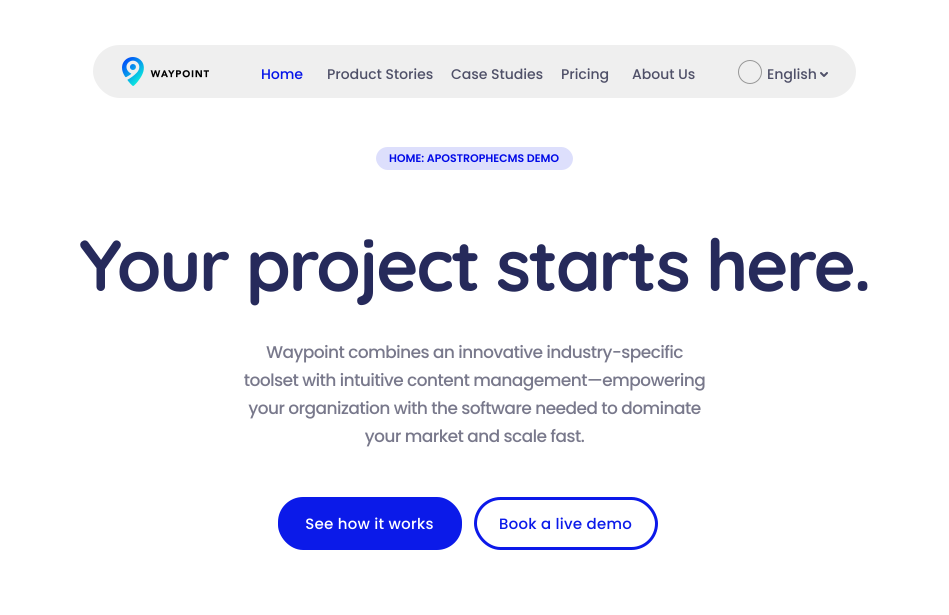
ApostropheCMS Essentials Starter Kit
The official minimal starting point for ApostropheCMS 4 projects. Ships with a home page, a default page type, a basic layout, and the Vite asset pipeline — enough structure to build on without opinions you'll need to undo.
Use it as-is for simple sites, or fork and extend it as your own organizational starter.
Prerequisites
| Requirement | Version | Link |
|---|---|---|
| Node.js | 22+ LTS | https://nodejs.org |
| Database | — | MongoDB 8+, SQLite (no server), or PostgreSQL 14+ |
Quickest local setup: use SQLite — no database server required. Set
APOS_DB_URI=sqlite://./data/my-project.dbin.env.
Quick Start
git clone https://github.com/apostrophecms/starter-kit-essentials.git my-project
cd my-project
cp .env.example .env
# Edit .env — set APOS_DB_URI at minimum (see Environment Variables below)
npm install
node app @apostrophecms/user:add admin admin
npm run dev
Open http://localhost:3000 and log in at /login with username admin and the password
you entered above.
Using the CLI instead
npm create apostrophe@latest # follow the prompts
Architecture Overview
Browser
│ HTTP request
▼
Express (app.js)
│ Route matched by @apostrophecms/page
▼
Page module modules/<page-type>/index.js
│ Relationship fields joined (_field arrays populated)
│ data.global, data.home, data.user attached
▼
Nunjucks render
views/layout.html ← site chrome
└─ modules/<page-type>/views/page.html ← page content
└─ {% area %} tags
└─ modules/<widget-name>/views/widget.html
▼
HTML response
Key directories
| Path | Purpose |
|---|---|
app.js |
Entry point; all module registration |
modules/ |
One subdirectory per module |
lib/ |
Shared field config (import, don't duplicate) |
views/ |
Site-wide Nunjucks templates |
modules/asset/ui/src/ |
Client-side JS and SCSS |
See ARCHITECTURE.md for conventions, template inheritance details,
and the full data.* reference.
Adding a Widget
1. Create modules/<widget-name>/index.js:
export default {
extend: '@apostrophecms/widget-type',
options: { label: 'My Widget' },
fields: {
add: {
heading: { type: 'string', label: 'Heading' }
}
}
};
2. Create modules/<widget-name>/views/widget.html:
<div>
<h2>{{ data.widget.heading }}</h2>
</div>
3. Register in app.js under modules: '<widget-name>': {}
4. Add '<widget-name>': {} to an area's widgets config, or to lib/area.js.
Adding a Page Type
1. Create modules/<page-name>/index.js:
import areaConfig from '../../lib/area.js';
export default {
extend: '@apostrophecms/page-type',
options: { label: 'My Page' },
fields: {
add: {
main: { type: 'area', options: { widgets: areaConfig } }
}
}
};
2. Create modules/<page-name>/views/page.html:
{% extends "layout.html" %}
{% block main %}
<h1>{{ data.page.title }}</h1>
{% area data.page, 'main' %}
{% endblock %}
3. Register in app.js under modules: '<page-name>': {}
4. Add to modules/@apostrophecms/page/index.js → options.types:
{ name: '<page-name>', label: 'My Page' }
Environment Variables
Copy .env.example to .env. Never commit .env.
| Variable | Required | Description |
|---|---|---|
APOS_DB_URI |
Yes | Database connection string (see formats below) |
APOS_DEV |
No | Set to 1 to force admin UI rebuild on every restart |
APOS_DB_URI formats:
# MongoDB
mongodb://localhost:27017/my-project
# SQLite (no server needed — good for local dev)
sqlite://./data/my-project.db
# PostgreSQL (use underscores, not hyphens, in database name)
postgres://user:password@localhost:5432/my_project
Before Going to Production
- Update
shortNameinapp.js— used as the database name - Set a unique session
secretinmodules/@apostrophecms/express/index.js - Run
npm run buildto compile production assets - Start with
npm run serve(ornpm run releaseto install, build, and migrate in one step)
Resources
- ApostropheCMS Documentation
- ApostropheCMS Discord
- GitHub Discussions
- CLI Tool —
npm create apostrophe@latest - ARCHITECTURE.md — conventions, template reference, data sources
Apostrophe Core Team